
Blast Freezer Manufacturer in Pune
What is a blast freezer?
A blast freezer is an insulated room or cabinet that freezes food fast, using air at −30 to −40 °C. Food processors use it to bring meat, poultry, seafood, ready meals and bakery products to a −18 °C core before storage. Falcon Refrigeration designs, makes and installs blast freezers in Pune and across Maharashtra.
It is a process room, not a store. Product goes in warm or chilled and comes out frozen to the centre. It then moves to a frozen store held at about −18 °C. We build those stores too, as a cold room manufacturer in Pune.
You may also hear the names shock freezer or air blast freezer. A blast chiller is a different machine. It cools cooked food from +70 °C to +3 °C within about 90 minutes, without freezing it.

How it works
Why freezing speed matters
Food is mostly water. When it freezes slowly, large ice crystals grow and break the cell walls. On thawing, the food loses juice (drip loss), and its texture and taste suffer.
Fast freezing forms many small crystals instead. The product keeps its structure, colour and moisture. It also passes quickly through the temperature range where bacteria grow.
Main parts of the system
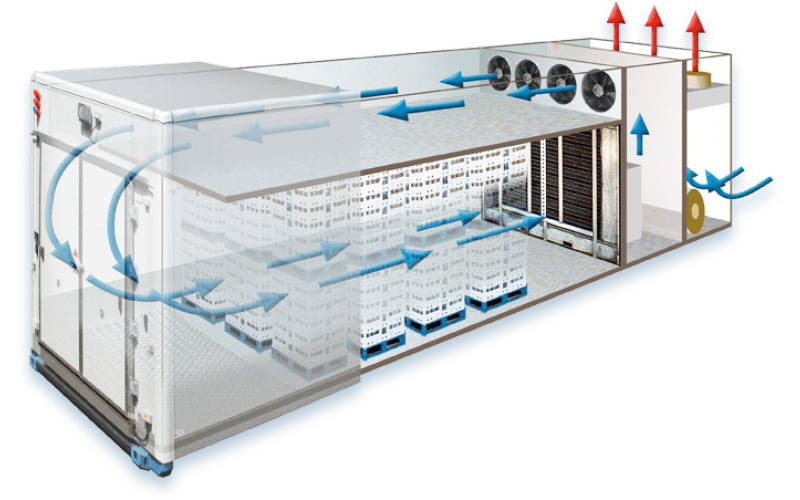
- Evaporator with high-velocity fans: moves cold air across every tray, trolley or carton. Air speed matters as much as air temperature.
- Compressor and condenser: a condensing unit sized for the heat in the product, not only the heat leaking through the walls.
- Insulated enclosure: PUF panels on the walls and ceiling, plus an insulated floor. They keep heat out and stop condensation on the outside.
- Door: a sealed, insulated cold room door with a heated frame, so it does not freeze shut.
- Defrost and controls: a defrost cycle clears ice from the evaporator coil. The controller sets the air temperature, and a food probe can end the cycle when the core reaches target.
After loading, the room pulls the batch down to temperature. The product then moves to storage, and the room is ready for the next batch.

Temperature and freezing time
A normal storage freezer runs at about −18 °C. A blast freezer runs its air much colder, at −30 to −40 °C, and moves that air fast. The target is the same: a product core of −18 °C.
| Point | Storage freezer (frozen store) | Blast freezing room |
|---|---|---|
| Air temperature | About −18 °C | −30 to −40 °C |
| Air speed | Low | High, directed across the product |
| Job | Holds food that is already frozen | Freezes warm or chilled food |
| Product core | Stays at about −18 °C | Brought down to −18 °C |
How long does freezing take?
Freezing typically takes a few hours, depending on product thickness and load. Take product about 50 mm thick on open trays in −35 °C air. It often reaches a −18 °C core in 2 to 4 hours. Boxed, stacked or thicker product takes longer.
The actual time in your plant depends on:
- Product thickness and packaging (the biggest factor)
- Starting temperature, for example fresh-cooked or pre-chilled
- Batch weight compared with the refrigeration capacity
- How freely air can flow around each item
We size the system from your batch weight, product and target time. Overloading the room is the most common reason freezing runs slow.
Blast freezer or blast hardener?
Both use very cold, fast-moving air, but they do different jobs. A blast freezer takes unfrozen food down to a frozen core. A hardener finishes ice cream that leaves the ice-cream freezer already part-frozen at about −5 °C. For ice cream, kulfi and frozen desserts, see our blast hardener for ice cream hardening.
Applications in food processing
- Meat: cuts, mince and processed products such as sausages and kebabs, frozen before cold storage or dispatch.
- Poultry: whole birds, portions and marinated products, frozen soon after processing to limit bacterial growth.
- Seafood: fish, prawns and shellfish, frozen quickly to keep texture and reduce drip on thawing.
- Ready meals: cooked dishes, gravies, parathas and snacks, often chilled first and then frozen in trays.
- Bakery: dough, par-baked bread, cakes and pastries, frozen so they can be baked or sold later.
- Vegetables and fruit: peas, sweet corn, cut vegetables and fruit pulp for frozen food brands.
- Central and hotel kitchens: batch-cooked food frozen for later use, which cuts waste.
Benefits of fast freezing
- Better texture, colour and taste after thawing, because ice crystals stay small.
- Less drip loss, so the product keeps more of its weight and value.
- Food passes quickly through the range where bacteria multiply.
- A frozen surface layer forms fast, which reduces drying and freezer burn.
- Longer shelf life, so you can freeze in season and sell all year.
- Planned batch production, with fewer rush jobs and less waste.
What affects the cost?
Every room is built to its load, so the price depends on the specification. The main cost factors are:
- Batch weight and target freezing time, which set the refrigeration capacity
- Room size, panel thickness and floor insulation
- Refrigerant and type of condensing unit
- Trolleys, racks or trays, and the door type
- Site work: civil work, power supply and installation access
Running cost matters as much as build cost. A room working at −35 °C uses a lot of power, so correct sizing and good seals pay back. For an existing plant, a refrigeration energy audit shows where power is being lost.
Typical specifications (confirm for your project)
| Item | Typical industry range |
|---|---|
| Air temperature | −30 to −40 °C |
| Product core target | −18 °C |
| Wall and ceiling panels | PUF, 125–150 mm, density about 40 ± 2 kg/m³ |
| Refrigerant | R-404A, R-507A, R-448A or R-449A; ammonia in large plants |
| Defrost | Electric or hot gas |
| Loading | Trays, trolleys, racks or pallets |
| Door | Hinged or sliding, with heated frame |
We confirm each value after studying your product, batch size and site. We install these rooms for food plants in Pune and other cold rooms across Maharashtra.
Frequently asked questions
What is the difference between a freezer and a blast freezer?
A storage freezer holds food that is already frozen, at about −18 °C, with gentle air movement. A blast freezer freezes warm or chilled food, using air at −30 to −40 °C blown fast across the product. It brings the core to −18 °C within hours. The food then moves to a storage freezer.
What is the coldest blast freezer?
Most food blast freezers run their air at −30 to −40 °C. Colder air is possible, but for most foods it adds power cost without a clear gain in quality. Rooms held between −40 and −80 °C are ultra-low temperature cold rooms. They are used for special products, not everyday food freezing.
How long does a blast freezer take to freeze food?
It typically takes a few hours. Product about 50 mm thick on open trays in −35 °C air often reaches a −18 °C core in 2 to 4 hours. Thicker, boxed or tightly stacked product takes longer. We confirm the freezing time for your product and batch size during design.
What is another name for a blast freezer?
It is also called a shock freezer or an air blast freezer, and some people say flash freezer. A blast chiller is a different machine. It cools cooked food from +70 °C to +3 °C within about 90 minutes, without freezing it. Some cabinets are built to do both jobs.
How much does a blast freezer room cost?
The cost depends on batch weight, target freezing time, room size, panel thickness, refrigerant and site work. Each room is built to your load, so there is no fixed price. Share your product, batch size and available space with us, and we will send a specification and a quotation.