
Cold Room Condensing Unit Manufacturer in Pune
What a cold room condensing unit is
A condensing unit is the outdoor half of a cold room refrigeration system. It combines the compressor, condenser coil, fans and controls, and rejects the heat taken out of the room. Units serve chillers at +2 to +8 °C and freezers at −18 to −25 °C. Falcon Refrigeration designs, makes and installs them in Pune and across Maharashtra.
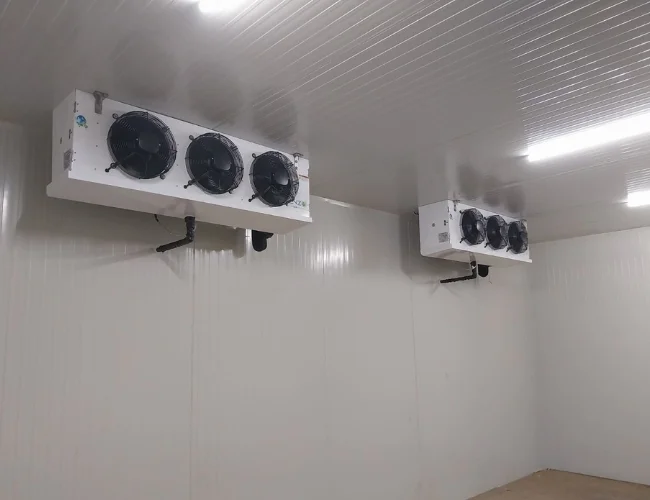
Inside the room sits the evaporator, also called the unit cooler. It is a separate part, linked to the outdoor unit by copper refrigerant pipes. Together they form a split system.
How the refrigeration cycle works
- The compressor draws in low-pressure refrigerant vapour and compresses it to high pressure and temperature.
- The condenser coil releases that heat to outside air or water, and the vapour turns into liquid.
- An expansion valve drops the liquid's pressure before it enters the evaporator.
- In the evaporator, the refrigerant boils, absorbs heat from the room and returns to the compressor.
A typical unit also has a liquid receiver, filter drier, sight glass, and high- and low-pressure switches. A control panel with contactors, overload protection and a phase-failure relay protects the compressor.
Air-cooled vs water-cooled units
Air-cooled units
Air-cooled units use fans to blow outdoor air across a finned copper-aluminium coil. They need no water, cooling tower or pump, so they are simple to install and maintain. Most cold rooms and small freezers use this type.
Their capacity falls as the outdoor temperature rises. Maharashtra summers can pass 40 °C, so units must be selected for peak summer conditions. Place them in shade, with free airflow, so hot discharge air is not drawn back in.
Water-cooled units
Water-cooled units reject heat into water through a shell-and-tube or plate condenser. A cooling tower then cools the water. Condensing pressure stays lower in hot weather, which saves power on larger plants.
They need a reliable water supply, water treatment, pumps and regular tower cleaning. They suit large cold stores, process plants and sites with little room for air-cooled coils. Very large ammonia plants often use evaporative condensers instead.
Air-cooled vs water-cooled at a glance
| Point | Air-cooled | Water-cooled |
|---|---|---|
| Water use | None | Make-up water for the cooling tower |
| Hot-weather efficiency | Drops as ambient temperature rises | More stable |
| Installation | Simple outdoor mounting | Needs tower, pumps and water piping |
| Maintenance | Coil cleaning, fan checks | Water treatment, tube and tower cleaning |
| Typical use | Most cold rooms and freezers | Larger plants and multi-room sites |
Compressor types
Hermetic reciprocating
The motor and compressor are sealed inside one welded shell. These compressors are compact and low in cost, and suit small cold rooms. They cannot be opened for repair, so a failed compressor is replaced.
Scroll
Scroll compressors are also hermetic, but use two spiral scrolls instead of pistons. They run quietly, with little vibration and good efficiency. They are common on medium-sized chillers, and low-temperature models serve freezers.
Semi-hermetic reciprocating
The motor and compressor share a bolted housing that can be opened for service. Valves, bearings and other parts can be replaced on site. They suit larger rooms, freezers and heavy daily duty, such as a blast freezer.
Large industrial plants may use screw compressors. We choose the type from room temperature, heat load, running hours and service access.
Refrigerants used in India
The refrigerant affects efficiency, safety and future servicing. Common choices for cold rooms in India include:
- R404A: widely used in freezers and low-temperature rooms. Its global warming potential (GWP) is very high, so many buyers now consider alternatives.
- R134a: used in medium-temperature chillers. It works at lower pressures than R404A.
- R449A and R448A: lower-GWP blends that can replace R404A in many low- and medium-temperature systems. They have some temperature glide, so the system is set up to suit.
- R290 (propane): a natural refrigerant with very low GWP and good efficiency. It is flammable, so charge size, parts and installation must follow safety rules.
India has committed to phasing down HFC refrigerants under the Kigali Amendment. Choosing a lower-GWP refrigerant now can make future servicing easier.
Choosing the right unit for your room
Capacity is matched to the room's heat load at its evaporating temperature. The load includes heat through walls, product heat, door openings, lights, people and defrost.
Typical selections (confirm for your project)
| Application | Room temperature | Common compressor | Common refrigerants |
|---|---|---|---|
| Fruit, vegetable and dairy chiller | +2 to +8 °C | Hermetic or scroll | R134a, R404A, R449A, R290 |
| Frozen food store | −18 to −25 °C | Low-temperature scroll or semi-hermetic | R404A, R449A, R448A |
| Blast freezer | −30 to −40 °C air | Semi-hermetic, often two-stage | R404A, R449A, R448A |
| Fruit ripening room | +14 to +25 °C | Hermetic or scroll | R134a, R404A, R449A |
Rooms below −40 °C, such as an ultra-low temperature cold room, need cascade or two-stage systems. A ripening chamber needs extra capacity for the heat that ripening fruit gives off.
Units need stable three-phase power, within about ±10% of rated voltage. Long pipe runs need correct pipe sizing and oil traps on suction risers.
We usually supply the outdoor unit as part of a complete room, with evaporator, PUF panels, doors and controls. See how we build complete rooms as a cold room manufacturer in Pune.
Installation and maintenance
Installation
- Mount the unit level on a firm base or wall bracket, with service space on all sides.
- Keep the unit close to the room to shorten pipe runs.
- Pressure-test and evacuate the pipework before charging refrigerant.
- Earth the unit properly and protect it with correctly rated fuses or breakers.
- Never start the compressor without refrigerant or with service valves closed.
Routine checks
- Clean the condenser coil, because dust raises head pressure and power use.
- Check fan rotation, noise and motor current.
- Record suction and discharge pressures, and compare them with commissioning values.
- Look for oil stains at joints, which often point to a refrigerant leak.
- On water-cooled units, check water flow, pump operation and tower cleanliness.
- Tighten electrical terminals and check contactors for wear.
Rising power bills or long compressor run times often mean a dirty coil, low charge or poor airflow. A refrigeration energy audit measures these problems on site.
Send us your room size, temperature and product when you request a condensing unit quote.
Frequently asked questions
What is the difference between a condenser and a condensing unit?
A condenser is only the heat-exchange coil that turns hot refrigerant vapour into liquid. A condensing unit is a complete assembly. It combines the compressor, condenser, fans, receiver and controls on one frame. For a cold room, it connects by copper pipes to an evaporator inside the room.
Should I choose an air-cooled or water-cooled unit?
Most cold rooms use air-cooled units, because they need no water and are simple to maintain. Water-cooled units suit large plants, very hot sites or places with little outdoor space. They need a cooling tower, pumps and water treatment. We compare running cost and site conditions before recommending either type.
Which refrigerant is used for cold rooms in India?
R404A and R134a are still common, with R404A used mainly in freezers. Lower-GWP options such as R449A, R448A and R290 are growing as India phases down HFCs. R290 is flammable and needs a safety-rated design. The right choice depends on room temperature, system size and local service support.
Which compressor is right for a cold room?
Small chiller rooms often use hermetic reciprocating or scroll compressors. Scroll models are quiet and efficient for medium loads. Freezers, blast freezers and heavy-duty rooms often use semi-hermetic compressors, which can be repaired on site. We choose the type from your room temperature, heat load, running hours and service needs.
How often should the outdoor unit be serviced?
Most units need a check every three months, and more often in dusty areas. Clean the condenser coil, check fan motors, record pressures and inspect joints for oil stains. Tighten electrical terminals once or twice a year. Regular service keeps power use down and helps prevent compressor failure.