

Cold Room & Clean Room Door Manufacturer in Pune
Cold room and clean room doors
Cold room doors are insulated doors that seal refrigerated rooms, from +2 °C chillers to −25 °C freezers. Clean room doors are flush, easy-clean doors for pharma, electronics and hospital areas. Both keep heat, moisture and dust out. Falcon Refrigeration designs, makes and installs both types in Pune and across Maharashtra.
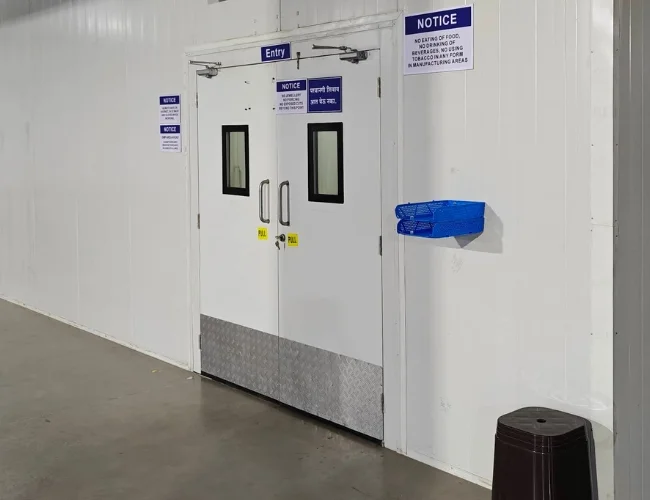
The door is the weakest point in any insulated room. It opens many times a day, and each opening lets in warm, moist air. A well-sealed door cuts frost on the evaporator, saves power and keeps product temperature stable.
Hinged vs sliding cold room doors
Hinged (swing) doors
Hinged doors suit walk-in traffic, trolleys and smaller openings. Cam-lift hinges raise the door as it opens and lower it onto the seal as it closes. A self-closing action cuts the time the door stays open.
Sliding doors
Sliding doors suit wide openings for pallet trucks and forklifts. The leaf runs on a top rail along the wall, so it needs no swing space. As it closes, it moves in against the frame to press the gasket tight.
Sliding doors can be manual or motorised. Motorised doors with sensors or pull cords help at busy loading bays.
Which door type suits your room
| Point | Hinged door | Sliding door |
|---|---|---|
| Typical traffic | People, trolleys | Pallet trucks, forklifts |
| Space needed | Swing area in front of the door | Clear wall beside the opening |
| Operation | Manual, self-closing | Manual or motorised |
| Common use | Small cold rooms, pharma stores | Cold stores, ripening rooms, warehouses |
For busy openings, add a PVC strip curtain or a high-speed door behind the main door. This limits warm air entry while the main door is open.
Door leaf construction
PUF-filled door leaves
The door leaf is a steel or stainless steel shell filled with rigid polyurethane foam (PUF). The foam density is usually about 40 ± 2 kg/m³. Leaf thickness normally matches the wall panels, typically about 80 mm for chillers and 100–150 mm for freezers.
Facings include pre-painted galvanised steel, or stainless steel (SS 304) for food and wet areas. We fit doors into rooms built from our PUF panels or sandwich PUF panels, so frame and wall seal well.
Gaskets and seals
Gaskets seal the gap between the door leaf and the frame. Cold room doors usually use EPDM, silicone or magnetic PVC gaskets on three sides. A bottom seal or drop seal closes the gap at the floor.
Check gaskets every month for tears, flattening or ice. A damaged gasket lets in warm air, which raises power use and frost build-up.
Hardware and safety
- Heavy-duty hinges or sliding rails sized for the leaf weight.
- A lockable handle with an inside emergency release, so no one can be trapped.
- An optional viewing window with heated or multi-layer glass.
- Kick plates and door buffers to protect against trolley damage.
Freezer door features
Doors on rooms below 0 °C need extra parts to stop ice forming and to protect the room.
Heater wires
A low-voltage heater wire runs around the door frame and, on some doors, along the threshold. It keeps the frame just above freezing. Without it, the gasket can freeze to the frame and tear when the door opens.
Pressure-relief ports
When warm air enters a freezer and cools, it shrinks and creates a partial vacuum. This makes the door hard to open and can strain the panels. A heated pressure-relief port, fitted in the wall near the door, lets air in or out to balance the pressure.
These features are standard on frozen food stores, blast freezer rooms and ultra-low temperature cold rooms.
Clean room doors
Clean room doors are built for rooms where dust and microbes must be controlled. They sit flush with the wall panels, with no ledges where dust can collect. Edges are sealed, so cleaning fluids cannot get inside.
- Flush, smooth faces in powder-coated steel or stainless steel.
- Flush, double-glazed vision panels.
- Drop seals and perimeter gaskets to hold room pressure.
- Optional interlocks for airlocks, so two doors cannot open together.
- Single-leaf or double-leaf options for people and equipment.
These doors are used in pharmaceutical plants, electronics assembly, hospitals, laboratories and food processing. If your facility follows GMP rules, share your validation needs with us at the design stage.
Choosing a door for your project
To specify a door, we need:
- Room temperature and use, such as chiller, freezer or clean room.
- Clear opening width and height.
- Traffic type: people, trolleys, pallet trucks or forklifts.
- Wall panel thickness and finish.
- Any hygiene or GMP requirements.
We supply doors on their own or as part of a complete room. See our work as a cold room manufacturer in Pune. For fruit, our ripening chambers use sealed doors to hold ethylene in.
Send us the opening size and room temperature when you request a door quote.
Frequently asked questions
What is the difference between a hinged and a sliding cold room door?
A hinged door swings open on cam-lift hinges and suits people and trolleys. A sliding door runs along a top rail and suits wide openings for pallet trucks and forklifts. Hinged doors need swing space in front of them. Sliding doors need clear wall space beside the opening.
Why do freezer doors need heater wires?
Heater wires keep the door frame slightly above freezing. Without them, moisture freezes between the gasket and the frame, so the door sticks and the gasket can tear. The wires run at low voltage around the frame. They are standard on doors for rooms that run below 0 °C.
What does a pressure-relief port do?
A pressure-relief port balances the air pressure between a freezer and the outside. When warm air enters and cools, it shrinks and creates a vacuum inside. This makes the door hard to open and strains the panels. The heated port lets air pass, so the pressure stays equal.
How thick should a cold room door be?
The door leaf usually matches the wall panel thickness. Chiller rooms often use PUF-filled doors about 80 mm thick, while freezers use 100–150 mm. Thicker leaves cut heat gain at lower temperatures. The final thickness depends on room temperature, door size and the panel system used for the walls.
How often should door gaskets be replaced?
Replace a gasket as soon as it is torn, flattened or no longer seals evenly. There is no fixed interval, because busy doors wear faster. Check gaskets every month for gaps, ice and damage. A simple test is to close the door on a sheet of paper; it should grip firmly.